Positive ovulation test with PCOS: did I actually ovulate?
16 Oct 2026
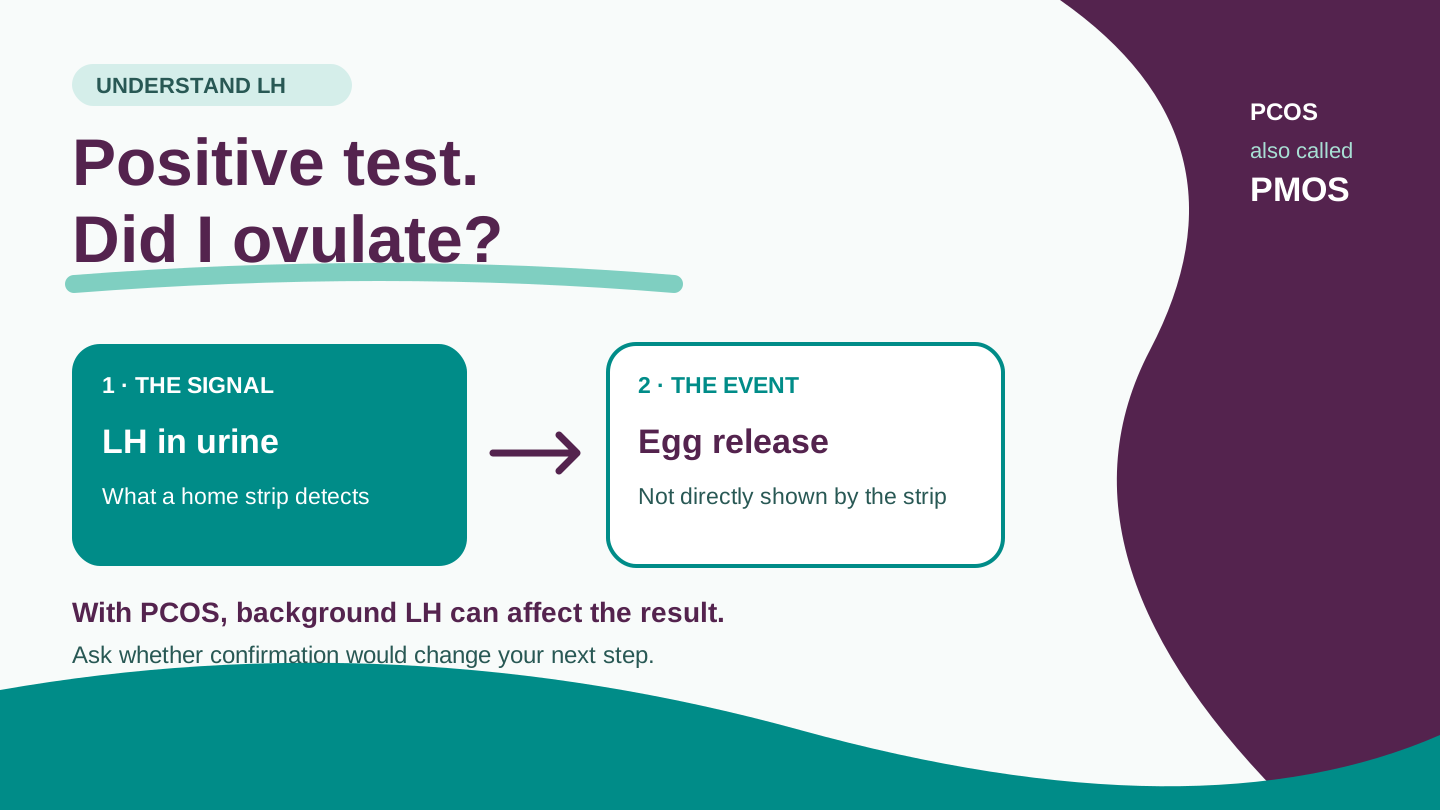
A positive ovulation test with PCOS does not, by itself, confirm that an egg was released. The strip detects luteinising hormone (LH), a signal associated with approaching ovulation. In PCOS, background LH can be higher, which can make some urinary results misleading. The useful question is what your pattern can establish—and whether confirming ovulation would change your next step.
It is easy to turn a line or smiley face into a verdict: “I ovulated, so why am I not pregnant?” But the measurement and the conclusion are different. A home test can be giving a real reading without answering the whole question you are asking of it.
Our Complete Guide to PCOS and PMOS explains the wider condition, diagnosis and care options. Here, we focus on that gap between a hormone signal and an event.
First, a note about the name
You may now see PMOS—polyendocrine metabolic ovarian syndrome—in NHS and international resources. The international guideline community introduced the name in May 2026 for the condition previously called PCOS. It is the same condition. We use the familiar PCOS wording here because it remains common in searches, discussions and existing diagnoses.
What does an LH strip actually measure?
ASRM describes urinary LH testing as indirect evidence of ovulation: a midcycle rise normally precedes egg release by around one to two days. The strip samples the signal in urine; it does not observe the follicle opening. Prediction and confirmation are different jobs.
Think of a departure board at a station. A train being announced is useful information for planning when to be there. It is not a record that the train completed its journey. In the same way, an LH result can help with timing without documenting every event that follows.
This distinction is useful even without PCOS. A device can only report what it measures. Marketing language, an app's coloured circle and the understandable hope attached to a result can make that narrow measurement feel much larger.
Why can PCOS make the answer less straightforward?
ASRM notes that people with PCOS may have persistently elevated background LH, leading to false-positive urine tests. Test accuracy also varies across products. That does not mean every positive result in PCOS is false, or that a person with PCOS cannot ovulate. It means the diagnosis and the pattern belong in the interpretation.
Two opposite conclusions cause trouble: treating every positive strip as proof of egg release, and dismissing every strip because of the diagnosis. A better approach is to ask whether the particular tracking method is giving information that helps you make a decision.
If the answer remains unclear after repeated testing, buying more strips may simply reproduce the uncertainty. Before adding another device, define what you need to know and how knowing it would change the plan.
Three patterns, three useful conversations
- A positive test on many days: tell the clinician that the result is persistent rather than a clearly isolated change. Ask whether LH tracking is useful in your situation and what alternative assessment would answer the question.
- One apparent surge but uncertainty afterwards: record the date and subsequent bleeding pattern. If confirmation matters, agree a method and timing with the clinician rather than regard the strip as a completed ovulation record.
- No clear positive test and very irregular cycles: ask about the cycle pattern itself. The next useful step may be assessment of ovulatory dysfunction and its cause rather than an instruction to keep searching for a peak.
These are discussion examples, not diagnoses from a photograph of a strip. Bring the product instructions and a brief record if available, but you do not need a perfect chart to explain that tracking is not resolving your concern.
What can help confirm ovulation when that would change care?
A clinician may use appropriately timed progesterone or ultrasound assessment, depending on the situation. Progesterone sampling is generally planned around a week before the expected next period rather than automatically on day 21. A single value can support evidence of recent ovulation but cannot grade the whole luteal phase.
If that timing question is your main concern, see our separate day-21 progesterone explainer. Here, the key decision comes first: would confirmation change treatment, timing or the next investigation? If so, the method needs to fit that purpose.
The international PCOS guideline also notes that ovulatory dysfunction can occur with regular cycles. That is a reason to investigate a relevant question in context, not to tell everyone with predictable periods that reassuring information should be distrusted.
What if you are planning insemination or already having treatment?
For donor-sperm insemination, ask the clinic how timing will be established before using a limited sample. For prescribed ovulation treatment, follow the team's monitoring and medicine instructions. A home result should not be used to change a dose, book a procedure independently or decide whether a treatment cycle has succeeded.
Make the practical question explicit: “Which result should trigger contact, and who makes the next decision?” That is more useful than comparing strips with a stranger whose medicines, protocol and cycle may be different.
What if ovulation is confirmed but pregnancy has not happened?
Let that result answer the question it can answer. The wider pathway may involve sperm, transport through the fallopian tubes, fertilisation and the uterus, depending on your conception route. An ovulation result should not make the person with PCOS carry every unanswered question alone.
Agree what needs attention next and when the plan will be reviewed. You can seek advice about irregular cycles or a specific fertility concern without waiting for a particular deadline. Equally, a person learning about their body does not automatically need a full investigation or a treatment programme.
A more useful endpoint than another positive strip
A clear plan distinguishes what is known, what remains uncertain and what action follows. For some people, education is enough for now. For others, targeted assessment or treatment is appropriate. Progress means using information to make the next decision, rather than collecting a longer sequence of symbols with no agreed interpretation.
Read the PCOS and PMOS guide's ovulation and care sections to connect your tracking question with diagnosis, wider health and the support that fits your current goal.
Questions people ask
Does a positive test mean I am definitely ovulating?
No. It detects LH. If confirmation would change care, discuss the appropriate method and timing rather than assume the strip directly recorded egg release.
Should everyone with PCOS stop using ovulation tests?
No universal rule follows from the diagnosis. Ask whether the method is informative for you and whether it supports an actual decision.
Do I need to be trying for pregnancy to ask about my cycle?
No. Understanding symptoms, cycle changes and future options is a valid reason to seek information or advice.
Sources
- ASRM: Fertility evaluation of infertile women, committee opinion (2021), sections on LH testing, progesterone and ultrasound.
- International evidence-based PCOS/PMOS guideline recommendations (2023); current ASRM version checked 16 October 2026, including recommendation 1.1.5.
- Endocrine Society: PCOS to PMOS name change, 12 May 2026.
- NHS: Polyendocrine metabolic ovarian syndrome, current patient information accessed 16 October 2026.
Sources checked 16 October 2026. Individual monitoring and treatment decisions belong with the clinician responsible for your care.
.jpg)

.jpg)