Can testosterone be normal while sperm production is low?
24 Oct 2026
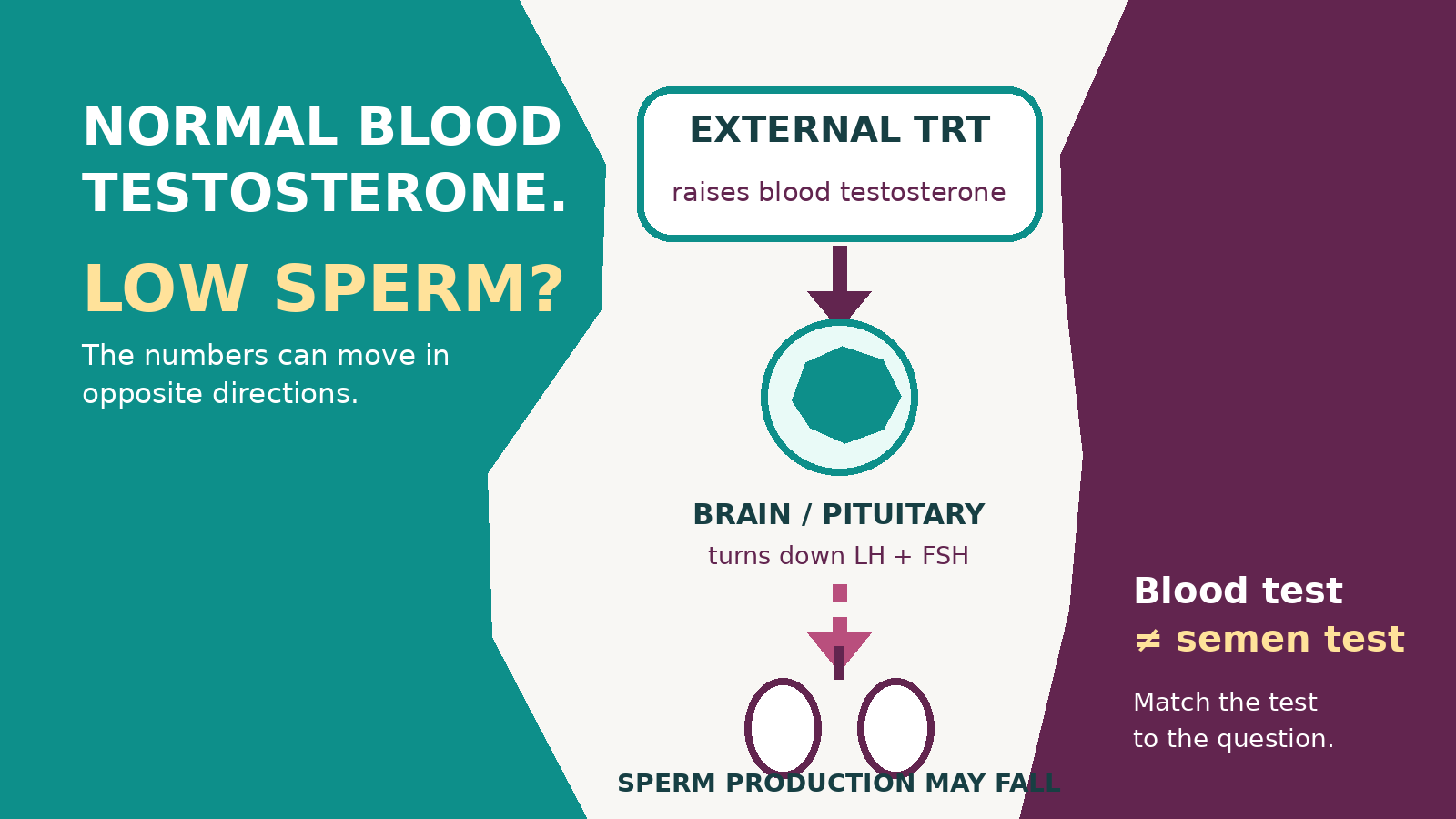
Yes. A blood testosterone result can be normal or high while sperm production is low. Testosterone replacement therapy raises testosterone in the bloodstream, but it can also suppress LH and FSH—the pituitary signals that help the testes maintain the very high local testosterone environment needed to make sperm.
That apparent contradiction is the reason a blood result cannot answer “Am I producing sperm?” The direct test is a semen analysis. The wider explanation comes from the treatment history, symptoms, hormone pattern and clinical assessment.
Our new guide to testosterone treatment and sperm production connects that mechanism with testing, recovery uncertainty, preservation and questions for the prescriber.
Blood testosterone and testicular testosterone are not the same measurement
The brain and pituitary normally coordinate sperm production through a signal pathway. Gonadotrophin-releasing hormone prompts the pituitary to release luteinising hormone (LH) and follicle-stimulating hormone (FSH). LH supports testosterone production by Leydig cells inside the testes; FSH and high local testosterone support the Sertoli cells involved in developing sperm.
When testosterone is supplied from outside the body, feedback to the brain and pituitary can reduce LH and FSH. Blood testosterone may improve, yet the testes receive less stimulation. Intratesticular testosterone falls and sperm production may decline.
This is why two statements that sound incompatible are both true: testosterone is essential for sperm production, and external testosterone can suppress sperm production.
A good symptom response does not answer the fertility question
Someone may feel more energetic, notice improved libido or see a satisfactory blood level on TRT. Those can be relevant treatment outcomes. They do not establish that sperm concentration, movement or total number are preserved.
The same separation applies in reverse. A low testosterone result does not tell you the sperm count. The original diagnosis, general health and symptoms still need proper evaluation, while semen analysis addresses the reproductive measurement.
Use the test that matches the question. Blood tests help investigate the hormonal pattern. Semen analysis looks for sperm in an ejaculate and measures the sample. Neither is a complete fertility verdict.
What can happen to a semen result on TRT?
The effect varies. Concentration may fall, several parameters may change, or no sperm may be seen in the ejaculate. Azoospermia is a finding that requires confirmation and investigation; it does not prove permanent infertility and it does not identify the cause by itself.
Product, dose, duration, baseline testicular function and individual response can influence the picture. Do not assume that one formulation is fertility-safe because somebody else maintained a count, or that a particular number of months predicts your result.
A diagnostic semen analysis provides current evidence. If the result is severely reduced or shows no sperm, prompt male reproductive assessment is more useful than a sequence of unsupervised supplements or repeated home screens.
What should happen before testosterone treatment?
If biological parenthood may matter now or later, say that before treatment where possible. AUA testosterone guidance recommends a reproductive-health evaluation for men interested in fertility before treatment. AUA/ASRM male-infertility guidance says testosterone monotherapy should not be prescribed to someone interested in current or future fertility.
That statement does not supply one universal substitute. It should open a person-specific discussion: why testosterone is low, what symptoms require treatment, whether baseline semen analysis is useful, whether sperm freezing should be considered and which specialist should coordinate the plan.
Future planning is a valid reason for this conversation. You do not need to be trying for a baby before fertility becomes relevant to a prescription.
If you are already on testosterone, do not turn the article into a stopping instruction
Stopping or changing prescribed testosterone can affect symptoms and health. Contact the responsible clinician and make the reproductive goal explicit. Bring the exact product, dose and start date, earlier hormone results and any semen reports.
If pregnancy is the current goal, describe the timeline and the other reproductive roles in the plan. Male assessment should happen alongside the relevant assessment of eggs, ovulation, tubes, uterus or treatment route—not after everyone else has completed every test.
Non-prescribed testosterone and anabolic steroids can suppress the same pathway. Give a clinician an accurate list of compounds and dates. The purpose is to make the assessment safer and more useful, not to attach blame.
Does sperm production always recover?
Recovery often occurs after suppression is addressed, but the time and completeness vary. Evidence from male-contraception trials and selected infertility clinics cannot promise an individual's return to baseline.
A 2017 retrospective study followed 66 men who had azoospermia or cryptozoospermia after testosterone use. They stopped testosterone and received clinician-directed hCG plus a selective oestrogen-receptor modulator. Forty-six men—70%—reached a total motile sperm count above five million within 12 months. Older age and longer exposure were associated with slower recovery.
Keep the denominator and endpoint attached to that statistic. It describes a treated specialist-clinic group and a laboratory threshold chosen for treatment planning. It was not a trial of stopping alone, did not show that 70% achieved pregnancy, and cannot set a personal deadline.
Can another medicine preserve fertility?
Male-fertility specialists may discuss hCG, selective oestrogen-receptor modulators, aromatase inhibitors or combinations in selected people with low testosterone and fertility goals. These options have different evidence, licensing, contraindications and monitoring needs.
They are not a self-treatment formula and should not be bought online or copied from a gym or social-media protocol. The right question is which option fits the diagnosis, symptoms and timing—and how the responsible clinician will measure benefit and harm.
Where sperm freezing fits
When viable sperm are present, freezing before treatment may preserve an option. A licensed clinic should explain sample requirements, infection screening, consent, storage, costs and how later use may involve IUI, IVF or ICSI.
The HFEA describes sperm freezing as the established method of preserving male fertility. Storage protects access to a sample; it does not guarantee a future pregnancy or birth. Urgent medical treatment should not be delayed for an elective optimisation period.
Four questions that change the prescribing conversation
- What diagnosis is testosterone treating? Separate symptoms from the evidence supporting the diagnosis.
- Could biological parenthood matter, and when? “Now”, “later” and “not sure” lead to different planning conversations.
- Would baseline semen analysis or sperm freezing change a decision? Use testing and storage for a defined purpose.
- Who owns the fertility part of the plan? Name the prescriber, male reproductive specialist or licensed clinic responsible for the next step.
The thought-provoking point is simple: raising the hormone number in blood can lower the reproductive signal reaching the testes. A useful plan respects both goals instead of assuming one laboratory result represents the whole system.
Plan the next question: use the Testosterone Treatment and Sperm Production guide for the testing map, preservation route, recovery evidence and appointment checklist.
Sources
- AUA/ASRM. Diagnosis and Treatment of Infertility in Men, guideline part II. Published 2021, amended 2024; testosterone and fertility recommendations checked 24 October 2026.
- American Urological Association. Evaluation and Management of Testosterone Deficiency. Fertility evaluation and counselling statements checked 24 October 2026.
- Kohn TP and colleagues. Age and duration of testosterone therapy predict time to return of sperm count after hCG therapy. Fertility and Sterility. 2017; retrospective cohort of 66 men.
- HFEA. Sperm freezing. Preservation, consent and storage information checked 24 October 2026.
Sources checked 24 October 2026. By ProFertility.