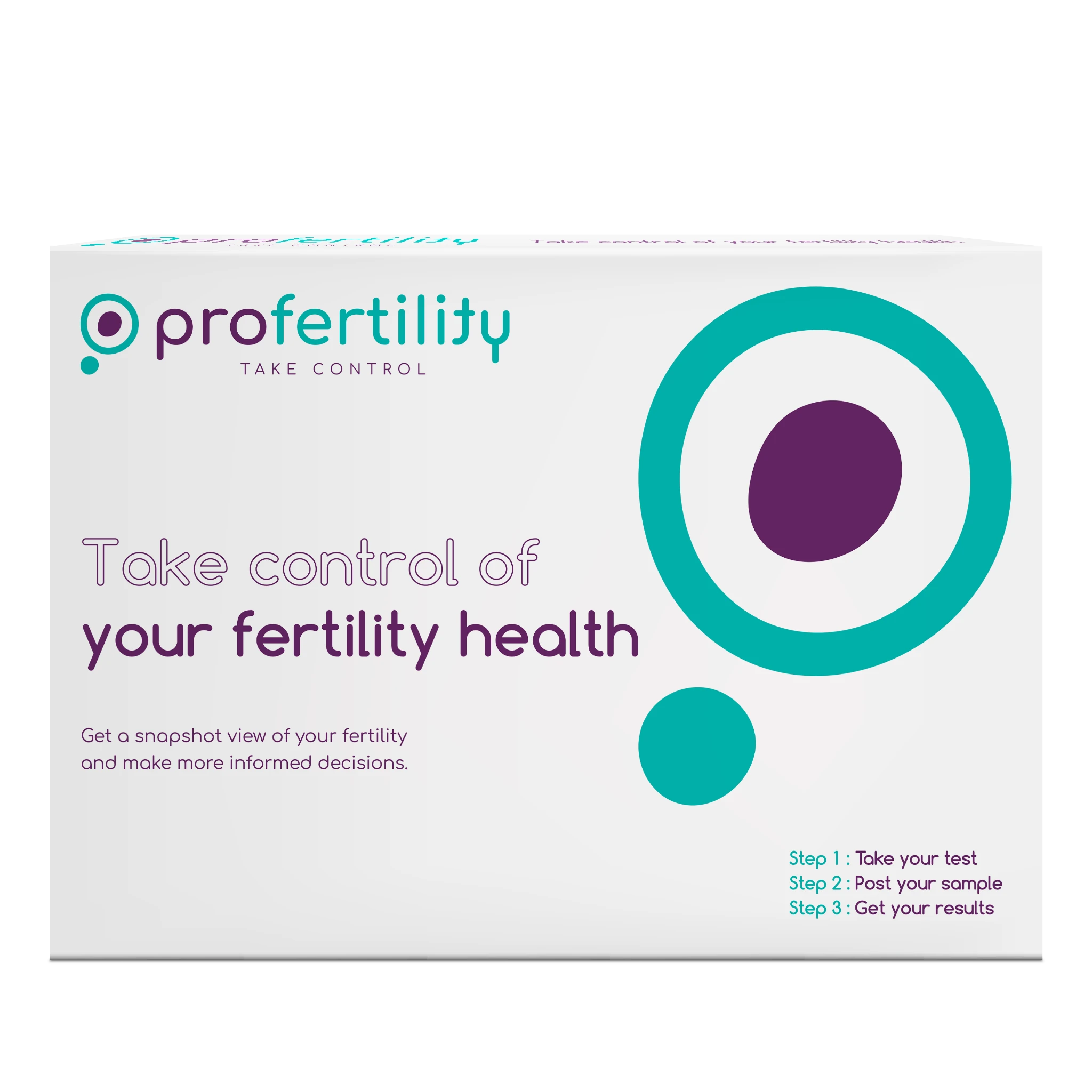
ProStarter For Women
Get a first look at your ovarian reserve and thyroid function with AMH and three thyroid markers.
- Anti-Müllerian Hormone (AMH)
- Thyroid Stimulating Hormone (TSH)
- Free T4
- Free T3
FERTILITY AWARENESS HUB
Your reproductive health matters before you’re trying, while you’re trying—and when you simply want to understand your body.
You do not need to suspect a problem to seek information. We help you move from uncertainty to clearer next steps, with at-home testing, specialist advice and support that starts where you are.
For women and men · Planning ahead or trying now · Private UK testing
AT-HOME FERTILITY TESTING
Get a clearer picture of your ovarian reserve, hormones or sperm health with ProFertility. Choose ProStarter for a focused first check, ProAdvance for more detail, or ProComplete for our broadest view.

Get a first look at your ovarian reserve and thyroid function with AMH and three thyroid markers.

Build on your ovarian reserve and thyroid results with FSH, LH and oestradiol for a fuller picture of your early-cycle hormones.

Get our broadest women’s hormone panel. Alongside the Advance markers, see your testosterone, SHBG and prolactin results.

Clinical-grade hormone testing from home. Decode those hot flashes
Ovarian reserve and hormones. AMH gives you a useful view of your ovarian reserve, an estimate of the pool of eggs remaining. ProStarter pairs AMH with thyroid markers. ProAdvance adds early-cycle hormones, and ProComplete adds testosterone, SHBG and prolactin for a broader view.
Sperm health. ProStarter shows sperm count, movement and shape alongside other core semen measures. ProAdvance gives you a more detailed analysis and a video of your sperm. ProComplete adds testosterone and FSH so you can see hormone results alongside your semen analysis.
Testing gives you a record of where things stand today, whether you’re planning ahead, trying now or checking your reproductive health. You can use your results to inform your plans and discuss any findings with our clinical team.
Choose your test kitCARE BEFORE CRISIS
We want reproductive health to feel just as normal to discuss. Understanding your body can start with learning about your cycle, checking your hormones or getting a clearer picture of your sperm health.
Curious, planning ahead, trying or already navigating a diagnosis: you deserve clear information and a practical route forward.
KEY AREAS FOR DISCUSSION
The conversations we started during Fertility Awareness Week continue here—alongside more about culture, sexual health, hormones and access. Explore clear information, practical tips and questions worth thinking about, whether or not having a baby is your goal.
10 conversations. Start wherever feels relevant.
Everyday health
You can care about reproductive health before pregnancy is on the calendar. Learning about hormones, cycles or sperm is a way to understand your health—not a declaration that something is wrong.
Testing gives you a record of your reproductive health today. A hormone test can give you information about ovarian reserve, thyroid function or early-cycle hormones. A semen analysis shows how many sperm are present, how they move and their shape.
AMH is a useful starting point for understanding ovarian reserve, especially when you’re planning ahead. It gives an estimate of the pool of eggs remaining. Our women’s ProStarter kit includes AMH and thyroid markers, and ProAdvance and ProComplete build on those results with a wider range of hormones.
For men, ProStarter measures eight core semen indicators. ProAdvance gives more detail about sperm movement and includes a video of your sperm. ProComplete adds testosterone and FSH, bringing your semen and hormone results together.
Family expectations & privacy
“Any baby news?” can carry more weight than the person asking realises. Marriage, parenthood and privacy look different across families and cultures. You choose what to share, when to seek support and what comes next.
A question can be well meant and still be painful. Someone may be trying privately, deciding against parenthood, managing a diagnosis, grieving a loss or simply enjoying life as it is. A birthday, wedding or family gathering does not entitle anyone to an update on their reproductive plans.
You do not have to explain your medical history to set a boundary. Decide in advance what you are comfortable sharing, who can know, and whether you want a partner or friend to help redirect the conversation. If you are a couple, agreeing a response together can reduce the pressure on one person to manage everyone’s expectations.
For friends and relatives, useful support starts with listening. Ask what would help rather than offering diagnoses, comparisons or promises. Even a thoughtful health gift is best discussed first. A voucher should offer choice and support, rather than imply that somebody ought to test, marry or have a baby.
Periods & menopause
Heavy bleeding, pain that disrupts your life and irregular cycles deserve attention. Endometriosis, PCOS and fibroids can affect reproductive health in different ways; having a condition does not automatically mean infertility.
Needing to change protection every one to two hours, use two products together, bleed through clothes or miss everyday activities can be signs of heavy periods. Our clinical team, including Dr Katherine (Katie) Sloane, our in-house GP, can discuss the pattern, possible causes and whether checks for anaemia or other investigations would be useful. Tracking changes helps describe what is happening; an app cannot diagnose the cause.
Menopause-type symptoms before 45 deserve a clinical conversation. Before 40, clinicians consider premature ovarian insufficiency (POI), particularly with absent or infrequent periods, flushes or vaginal dryness. Assessment also matters for bone and cardiovascular health.
NICE recommends diagnosing POI from the clinical picture and raised FSH on two blood samples, taken four to six weeks apart. A single home hormone result cannot establish it, and AMH is not routinely recommended for diagnosis.
It helps to describe the impact, not only the number of bleeding days. Pain that means missing work, planning journeys around toilets, doubling up protection or avoiding sex is useful clinical information. Treatment decisions can take account of whether you want contraception, pregnancy now, future fertility or symptom relief alone.
Faith & medical care
Faith can offer hope, comfort and community. Seeking medical information need not mean leaving spiritual support behind.
For some people, speaking to a faith leader and asking for prayers is the most natural first step. Parents or elders may encourage prayer, share a family remedy or suggest a practice that carries meaning in their community. The advice often comes from care and from people whose judgement matters to you. What feels right can vary even within the same family or congregation.
That closeness can make the next step feel complicated. You might worry that booking an appointment will be read as a lack of faith, or that seeking a test before you have tried everything your family suggested will seem disrespectful. You can be grateful for their support and still choose to find out what is happening in your body. There is room to pray, stay connected to your community and seek medical care without guilt.
A fertility difficulty is not a verdict on faith, character or worth. Prayer and community can give you comfort through uncertainty. A consultation or fertility test can give you information about your reproductive health and help you decide what comes next. You can book while you continue to pray. If you are weighing choices about treatment or donor conception, our specialists can explain the options and give you space to consider them alongside your beliefs.
Before an appointment, write down any questions about treatment, timing, privacy or involvement of a partner or faith adviser. Our consultants can explain what an investigation can show and what choices it may open up. You can then decide who, if anyone, you want alongside you when considering those choices.
Family building & planning ahead
Parenthood in your 40s deserves facts without judgement. Men deserve fertility care in their own right. Solo parents and LGBTQ+ families deserve to be included. Clear information and respectful care should not depend on fitting one family story.
Age affects fertility, especially with eggs, and can influence treatment options and pregnancy risks. A label such as “geriatric mother” does not explain someone’s individual health or choices. Ask for a discussion of your age, history and options that informs without shaming.
If you’re considering solo parenthood, you may be thinking about donor sperm, treatment costs, work and who can support you. A planning consultation can help you compare donor insemination and IVF, understand what a clinic may ask you to check, and put those decisions in an order that feels manageable.
For LGBTQ+ families, the first conversation should reflect who you are and how you want to build your family. Two partners may want to discuss donor sperm, who might carry, or reciprocal IVF, where one provides the eggs and the other carries. If your plans involve donor eggs or surrogacy, you may want to talk about sperm testing and which professionals to speak with first. Trans and non-binary people may also want to discuss fertility preservation, including how it fits around gender-affirming care.
Testing can give you something concrete to work with while you plan. AMH helps you understand your ovarian reserve and can inform a conversation about egg freezing or IVF. Our women’s ProStarter kit pairs AMH with thyroid markers, with more hormone detail available in ProAdvance and ProComplete. A semen analysis can give you a baseline for sperm count, movement and shape if you’re planning to use your own sperm or considering sperm freezing.
Age and timing can matter whether you’re single, partnered or still deciding. You can use a ProFertility consultation to talk through your timeline, health history and results. If a donor, clinic or preservation service will be involved, ask what you can do now and which steps to arrange with them.
Culture & expectations
Culture can be a source of belonging, wisdom and practical help. It can also shape what feels safe to ask about periods, sex, fertility or becoming a parent. No community has just one experience.
In some families, marriage comes with an expectation that pregnancy will follow quickly. Women may be asked for updates, blamed for delays or expected to arrange every appointment. There can be pressure around when and how often a couple has sex, even in families where talking openly about sex, pain or pleasure feels uncomfortable. Those pressures can make intimacy feel like a duty and leave little room for either partner to say what they need.
Men can face their own pressure. Where fertility is tied to masculinity or virility, being asked for a semen sample can feel like being asked to prove something. A man may feel embarrassed about collecting a sample or worry about who might see the result. His partner may want him to test and still be anxious that raising it will sound like blame. These conversations can feel particularly exposed when relatives already feel entitled to ask for baby news.
When fertility is hard to talk about, people may wait until a concern feels urgent or see testing as proof that something is wrong. Men’s involvement matters here too. Partners can learn together and share the work of arranging tests and appointments, so the responsibility doesn’t fall to one person.
You can make the conversation smaller and more private. A ProFertility home semen kit lets him collect the sample in private and learn about sperm count, movement and shape. If you’re testing as a couple, both partners can choose a check and agree how they want to discuss their results.
A private appointment can give you space to ask questions you would not raise at home. If sex has become stressful, painful or difficult to talk about, you can bring that up with our clinical team. You can also tell us about family expectations, cultural practices or privacy concerns that affect how you’d like to receive care.
Connected health
Gynaecology cares for conditions affecting organs such as the womb, ovaries, vagina and vulva. Reproductive health is broader: it includes hormones, sexual wellbeing, contraception, fertility and choices throughout life. Fertility concerns the ability to achieve a pregnancy; it is one part of that bigger picture.
Periods can give you useful clues about ovulation. Long gaps between periods can sometimes reflect infrequent ovulation, which matters if you’re trying to conceive and is worth understanding if you aren’t. PCOS can affect ovulation. Endometriosis can cause pelvic pain and affect fertility, while some fibroids can change the shape of the womb cavity. It’s common to start asking how these things fit together when you begin planning a pregnancy. You can start that conversation sooner.
If you’ve taken the pill for years, your usual cycle may be hard to picture. The combined pill suppresses ovulation while you take it, and different contraceptives can change the bleeding you see. If you decide to come off contraception, keeping track of when your own periods return can help you understand your cycle. If you want to stay on it, you can still discuss symptoms, changes and future plans with our team.
Gynaecological health also affects how you feel today. Heavy periods can deplete iron stores over time. Pelvic pain can affect sleep, work, exercise and sex. If you’ve been organising your life around bleeding or pain, those are reasons to get support in their own right, whether you want children, are undecided or your plans change later.
Our at-home hormone kits give you information about ovarian reserve and thyroid markers, with early-cycle hormone results available in ProAdvance and a wider hormone panel in ProComplete. If you’re trying to connect cycle changes, bleeding, pain or an existing diagnosis with your plans, our consultants can review that history alongside your results.
Sexual health & planning
Contraception, STI care and conception planning belong in the same conversation: understanding your body and making choices that fit your life.
Many people with chlamydia have no symptoms. Untreated infection can lead to pelvic inflammatory disease, which may affect fertility. Confidential sexual-health testing and treatment are routine health care, without judgement. Condoms help protect against STIs; hormonal contraception does not.
Most contraceptive methods do not cause a lasting delay in fertility after stopping, but the injection can delay its return for up to a year. Discuss timing when choosing or changing a method. Contraception does not stop ovarian ageing or “save up” eggs.
If pregnancy is a goal, our preconception consultations can review your health history, medicines, supplements and practical preparation. The usual advice is 400 micrograms of folic acid daily before conception and through the first 12 weeks; some people need a prescribed higher dose. Katie, our in-house GP, and our consultants can help decide what is appropriate. Keep taking prescribed medicines unless a professional advises a change.
For STI testing, tell the clinician about symptoms, the type of contact and when it happened, so they can discuss the right samples and timing. A negative test taken too early may need repeating. Our STI and preconception services give you a place to ask these questions confidentially; you do not need to be trying for a pregnancy to use them.
Testosterone & sperm
If you train hard, you probably know your lifts, times and recovery better than anyone. An at-home semen test gives you a way to get to know your sperm health too, whether you do CrossFit, lift weights, take testosterone or have used steroids in the past.
If you’re planning a family, thinking about freezing sperm or curious about where you stand, a semen test gives you a baseline you can keep. You’ll see how many sperm are present, how they move and their shape. You can collect your sample privately at home and fit the check around work and training.
If you take testosterone or have used anabolic steroids, sperm health is worth checking. Testosterone taken from outside the body and anabolic steroids can suppress the signals that drive sperm production. If you’re on testosterone now, a semen test can show where your sperm measures stand while you’re on it. If you’ve stopped steroids, you can check where things stand today and discuss when it would be useful to check again.
ProStarter gives you eight core semen measures. ProAdvance adds a more detailed breakdown of movement and other measures, with 16 in total and a video of your sperm. ProComplete gives you the full ProAdvance analysis plus testosterone and FSH from a finger-prick blood sample. It gives you sperm and hormone results to discuss together, especially if testosterone or past steroid use is part of your story.
Keep your first result and the date you tested. A follow-up can be useful after a change in treatment or to track changes over time. If you’re on prescribed testosterone, discuss your fertility plans and results with your prescriber before changing your treatment.
Access & outcomes
A long drive, a day off work or a wait to get referred can all put a fertility conversation on hold. With ProFertility you can order a test for home collection and speak to a specialist online, wherever you live in the UK.
The postcode gap is visible in who gets funded treatment. In 2024, the NHS funded 28% of UK IVF cycles. The share was 54% in Scotland and 25% in England. Within England, it was 51% in the North East and 20% in the South West and East Midlands. For people working out what they can afford or how far they can travel, those differences matter.
The HFEA also reported a gap in birth rates per embryo transferred across 2022–24. Among patients aged 18–37 using their own eggs, the rate was 30% for Black and Asian patients and 36% for White patients. Those figures make it worth asking whose concerns are being heard early, who can get to appointments and what support people have along the way.
For many people trying through regular unprotected sex, a year of trying is the usual point for an NHS fertility assessment, with earlier assessment in some circumstances. With ProFertility, you can order an at-home test now. You can check ovarian reserve and hormones or get a view of sperm health before trying, while you’re trying or while you’re waiting for another appointment.
Virtual appointments and at-home kits can reduce travel and scheduling barriers. If you live far from a clinic, work shifts, care for family or need more privacy, you can compare kit prices and what each test measures online, then collect your sample at home when it fits your day.
Our online consultations bring a range of specialists to you, including clinicians in reproductive medicine, gynaecology and male fertility. You can speak with the right specialist from home, talk through what’s on your mind or review your test results together. You can get the conversation started sooner and leave with a clearer idea of what to do next.
About 1 in 10 reproductive-age women worldwide have endometriosis.WHO: endometriosis →
10–13% of reproductive-age women worldwide are estimated to have PCOS.WHO: PCOS →
About 1 in 2 couples experiencing infertility have a male factor involved, either alone or alongside other factors.AUA/ASRM: male fertility →
The endometriosis and PCOS figures describe how common these conditions are, not the proportion who will experience infertility. The male-factor figure relates to couples experiencing infertility—not all men. Reproductive health deserves attention for women and men, whether or not pregnancy is the goal.
Explore our free Fertility Library →GET TO KNOW PROFERTILITY
Watch our About Us video and hear Nick’s and Emilia’s own accounts.
Our approach to clearer information and a practical plan.
Watch on Vimeo →Hear about ProFertility at-home sperm testing.
Watch on Vimeo →Hear Emilia discuss endometriosis and fertility.
Watch on Vimeo →FREE TO EXPLORE
Keep learning at your own pace. You do not need to buy a test to use these resources.
SUPPORT THAT FITS YOUR STARTING POINT
For symptoms, results, STI testing, preconception or future planning, our consultants can help you understand what deserves attention and what to do next. Our team includes Dr Katherine (Katie) Sloane, our in-house GP and fertility specialist.
Explore consultations →For people who need a coordinated pathway: assessment, relevant investigations, clinical review and a tailored programme with support and review.
Explore the Plan →Learn about reproductive health and find support through our free men’s and women’s communities. Paid courses are available separately.
CLEAR ANSWERS
No. Reproductive health includes periods, hormones, sperm, sexual health, contraception and the choices you make throughout life. The hub is for people who want children now, later, never or are still deciding, including trans and non-binary people.
Yes. An at-home kit gives you a starting point for understanding your ovarian reserve and thyroid markers or your sperm health. ProStarter is a focused first check, and ProAdvance and ProComplete offer more detail.
AMH gives you a view of your ovarian reserve, an estimate of the pool of eggs remaining. It is included in our women’s ProStarter, ProAdvance and ProComplete kits and can help inform conversations about future planning or fertility treatment.
You’ll learn about sperm count, movement and shape. ProAdvance adds a more detailed analysis and a video of your sperm. ProComplete combines the ProAdvance results with testosterone and FSH.
Yes. Speak with our consultants about STI testing and preconception support, including GP input from Dr Katherine (Katie) Sloane. The fertility hormone and semen kits shown here are not STI tests; our team can help arrange the appropriate assessment and explain which tests fit your needs.
Yes. This hub, the Fertility Library, A–Z and tools are free to explore. Frank and HerStory offer free community learning, with paid courses available separately. When you want individual advice, our consultants can discuss your symptoms, plans or results and help you choose the right next step.
Make room for your reproductive health—on your own terms.